Project
001
Closing the loop on Personal Hygiene Products
This project was part of a Service Design course focused on holistically designing services and systems with sustainability at the core. My team and I chose to explore personal hygiene products due to their high environmental impact and everyday relevance.
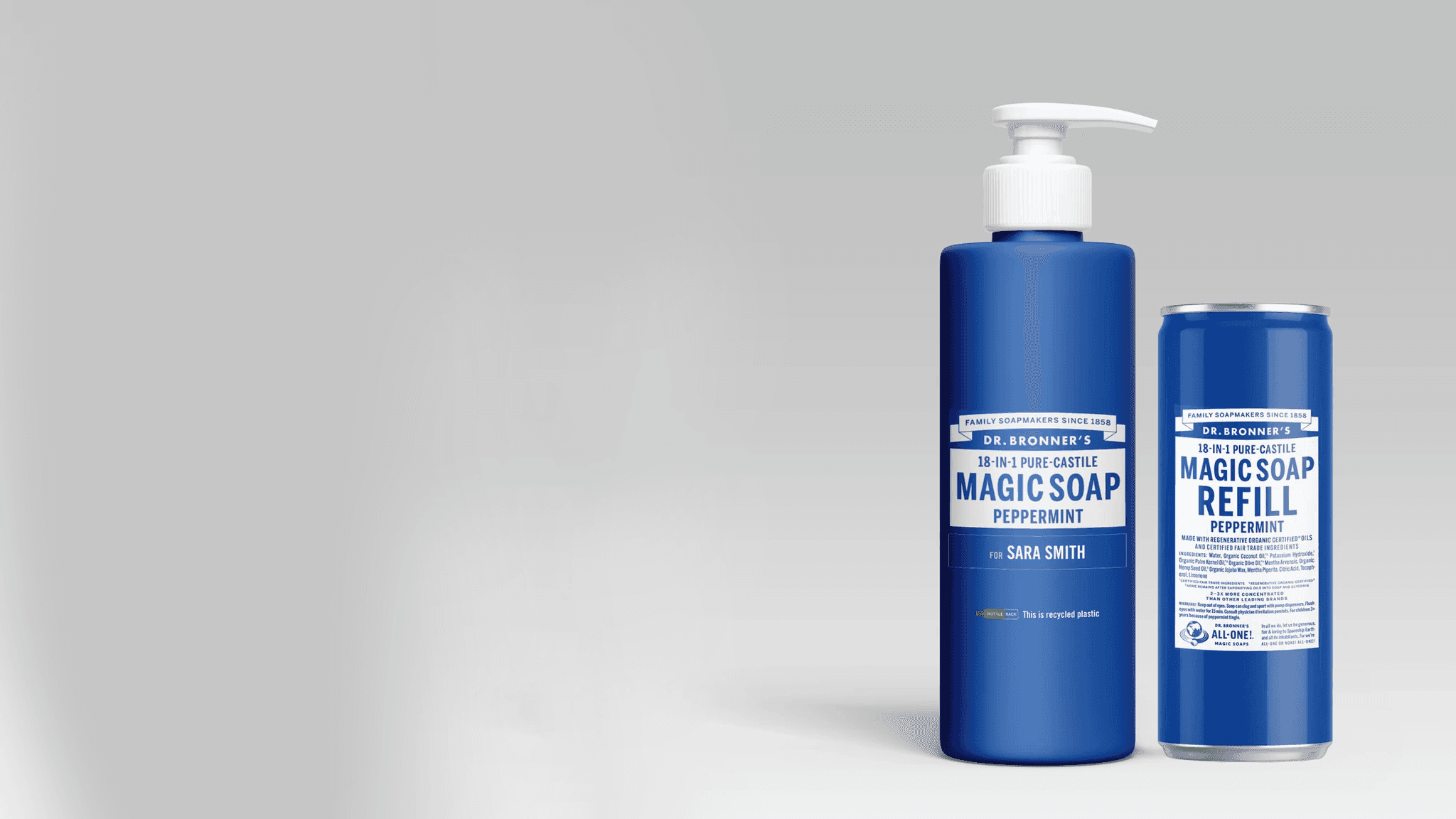
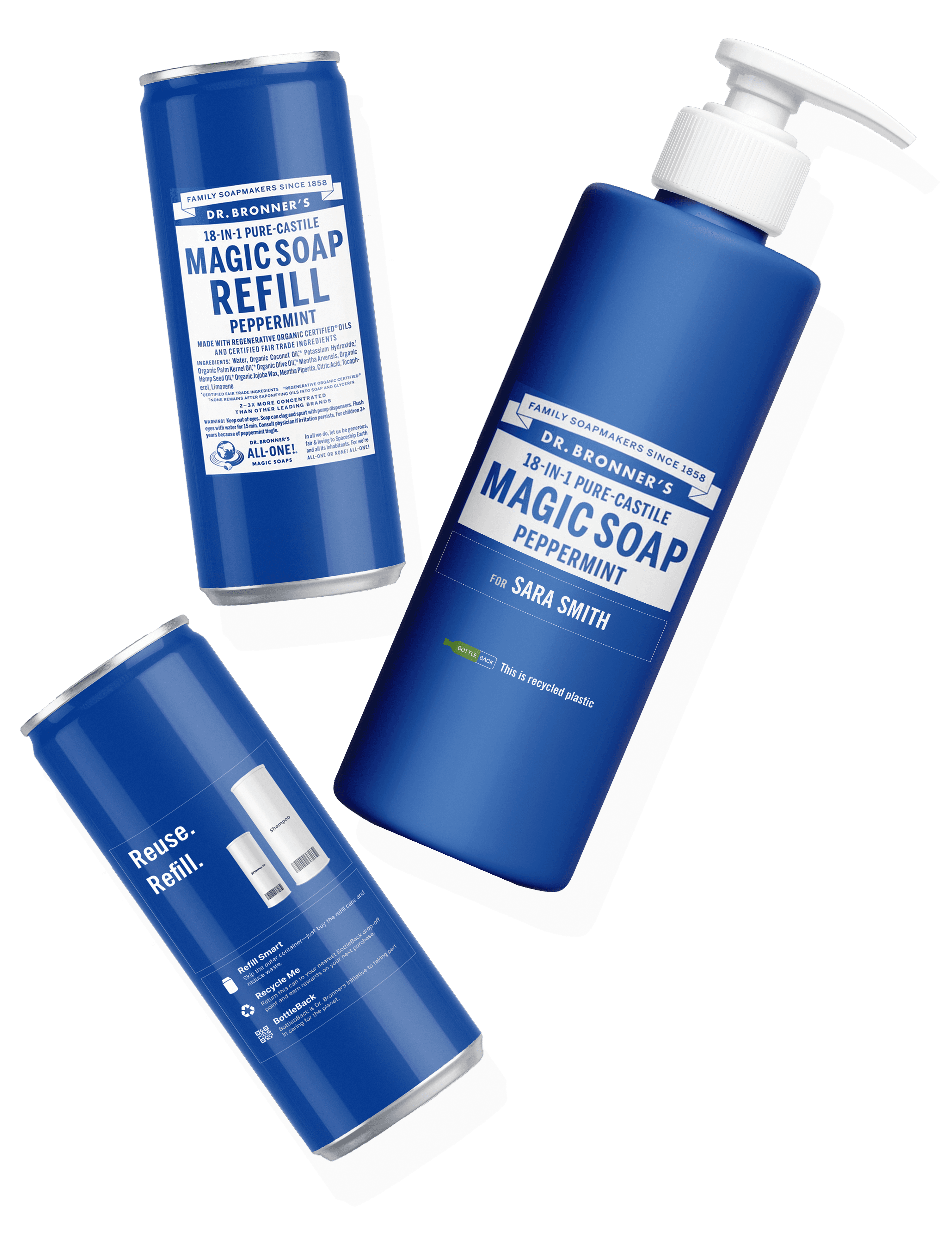
The outcome was Bottle Back, a speculative, closed-loop service designed in collaboration with a brand with similar values, Dr. Bronner’s. Bottle Back rewards consumers for returning cosmetic containers while promoting refill-based consumption to further reduce waste. The service is designed to benefit all stakeholders: consumers, the business and of course the environment.
Details
002
Role
Service & Product Designer
Timeline
03 Months
Collaborators
Ishita Kohli, Sharayu Kute, Itzel Mendias, Tobias B
Tools
Figma
Rhino 3D
3D Printer
Adobe Creative Suite
⚠️ NOTE: This project is entirely visionary and not affiliated with or endorsed by the real Dr. Bronner’s brand
Overview
003
Problem
Preliminary research showed that sustainability is rarely considered when choosing personal hygiene products. Instead, decisions are driven by aesthetics, convenience, and consumer habits, leading to significant packaging waste. This revealed a need to make sustainable choices easier and more integrated into everyday routines.
Outcome
We designed Bottle Back, a visionary closed-loop service that incentivizes returning empty or unused containers and promotes refills. By embedding sustainability into existing behaviors, the service encourages long-term behavior change while benefiting consumers, businesses, and the environment.
Solution
004
Final Design & Intervention
Our service empowers customers to feel confident when purchasing a cosmetic product that inspires them to make more Eco-conscious decisions. By providing refillable packaging for clean products they already tried and tested, users can continue using what works for them both conveniently and sustainably. Our service uses a clean and trusted brand and we keep the user well informed on how our bottles are recycled. The experience is designed to be uplifting and rewarding, encouraging users to adopt eco conscious habits while feeling good about their choices.
Values of the service
🪟
Trust & Transparency
🌿
Sustainability
✨
Convenience
NOTE: Values were selected to balance the needs of consumers, the business and it's employees, and the environment.
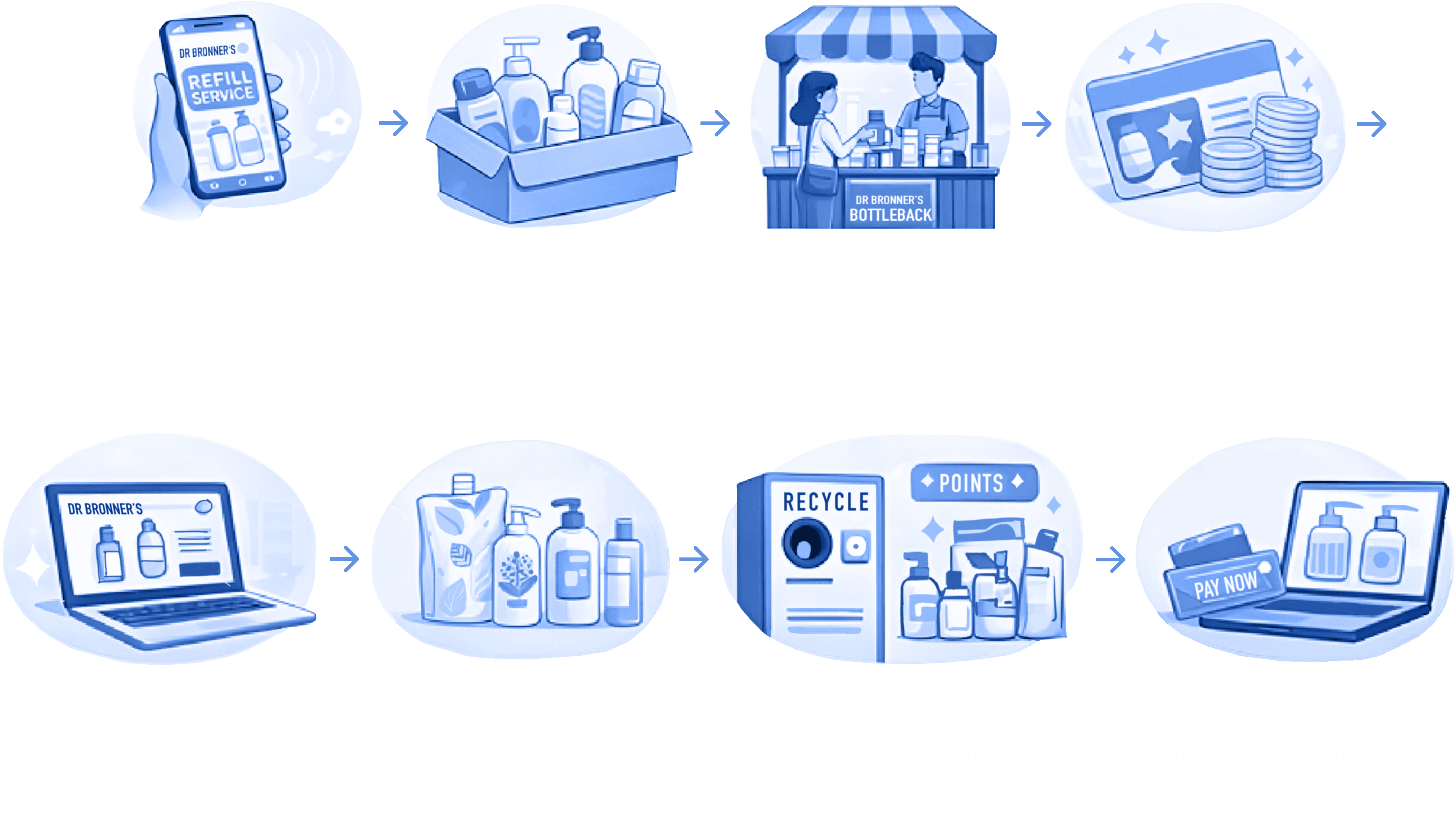
An Overview of the Service:
Our Approach
005
Why the Topic
006
Choosing a High-Impact Everyday System
We chose to focus on personal hygiene and beauty products because they sit at the intersection of deeply personal daily routines and large-scale environmental impact. These products are used consistently, replaced frequently, and packaged extensively, making them a powerful lens through which to examine sustainability and behavior change.

The teams feelings
A personal connect
The entire team felt that we had been influenced by skincare and beauty trends at some point, drawn in by buzzwords, aesthetics, convenience, and consumerism. Our attention is almost always on what a product promises to do and what it contains. This personal connection to the topic made us think : why aren’t we considering the environment?
Market.us News
18 Dec, 2024
The waste generated by the industry
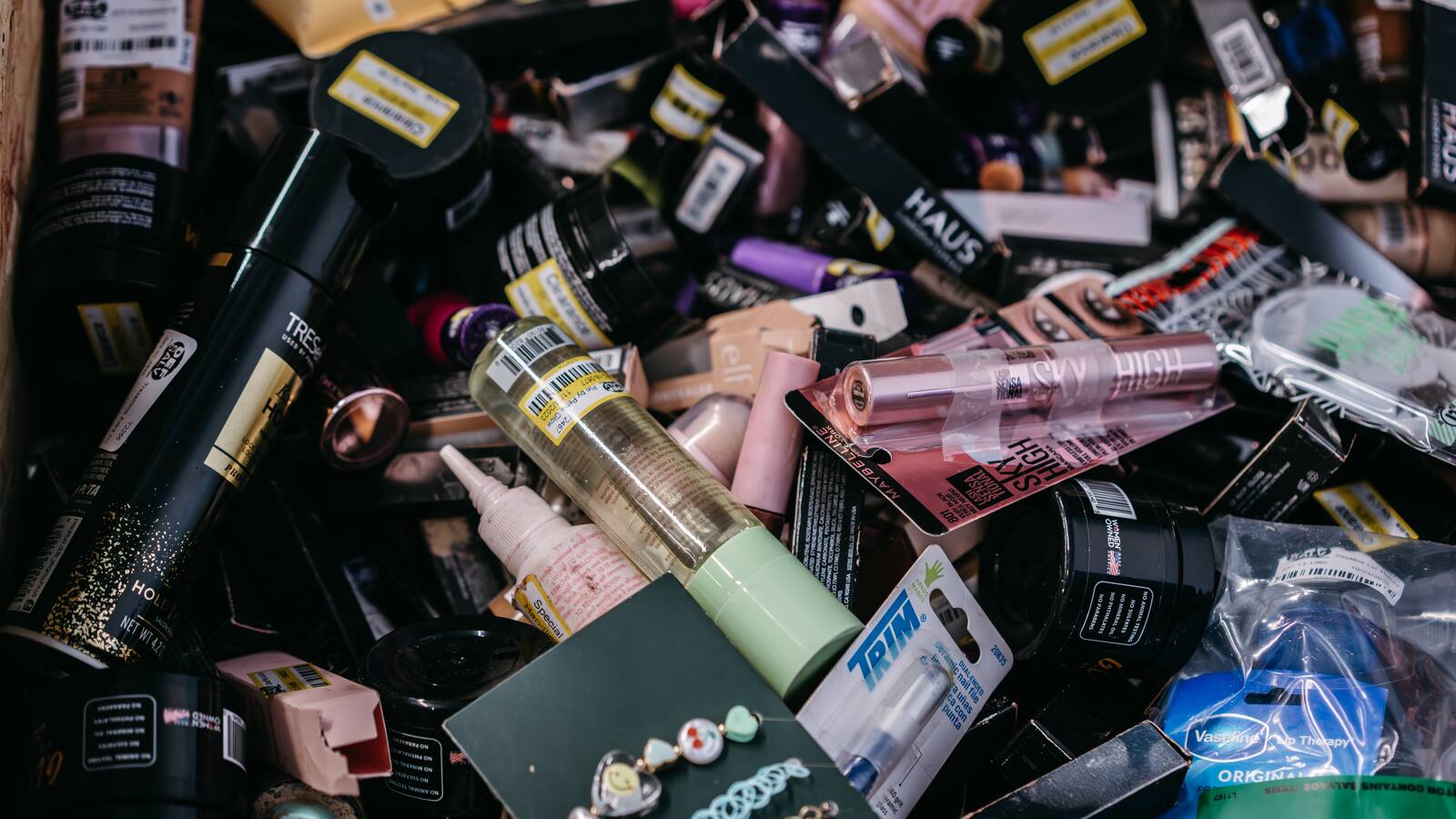
The beauty and cosmetics industry generates an estimated 120 billion units of packaging every year, the vast majority of which is single-use and quickly discarded. Even among plastics that are technically recyclable, less than 10% are actually recycled worldwide, leaving most packaging to end up in landfills or the environment.

Research
007
Preliminary Research
To better understand the gigantic space around sustainability in the cosmetic industry, we started with preliminary research which included the following research methods.
SECONDARY RESEARCH
Literature Reviews
White papers articles and research journals
FINDING
Adopting sustainable habits in cosmetics require easy steps, clear incentives, and better product efficacy.
PRIMARY RESEARCH
User Interviews
4 participants, remote. Users use cosmetic products regularly (at least weekly)
FINDING
Emotional well- being, cultural values, and aesthetics shape decisions. Social media can trigger impulses but friends and family play a larger role.
OTHER
Netnography
Observations on Reddit forums and Quora
FINDING
Uncertainty about disposal and a lack of guidance result in products being thrown away, even if the users are interested in sustainability.
Common Themes
008
With the data we generated across these research methods, we were able to come up with 6 major themes.
02
Purchasing Behavior
Emotional well- being, cultural values, and aesthetics shape decisions. Social media can trigger impulses but friends and family play a larger role.
03
Disposal Practices
Uncertainty about disposal and a lack of guidance result in products being thrown away, even if the users are interested in sustainability.
04
Lack of Regulation
Terms like "organic," "natural," "green," lack standard definitions, leading to vague brand claims, around ingredients & packaging materials without clear metrics.
Unregulated sourcing and waste disposal also cause ecological damage.
05
Lack of Information and Distrust
Consumers show low ingredient literacy but high concern for specific needs. While demand for clinical validation and transparency grows, unclear instructions, hidden costs, and missed expiry dates reduce trust.
06
Eco Exhaustion
Many are burned out by the focus on personal responsibility over corporate accountability, doubting true sustainability within the current beauty industry.
Artifacts
011
Ecosystems map
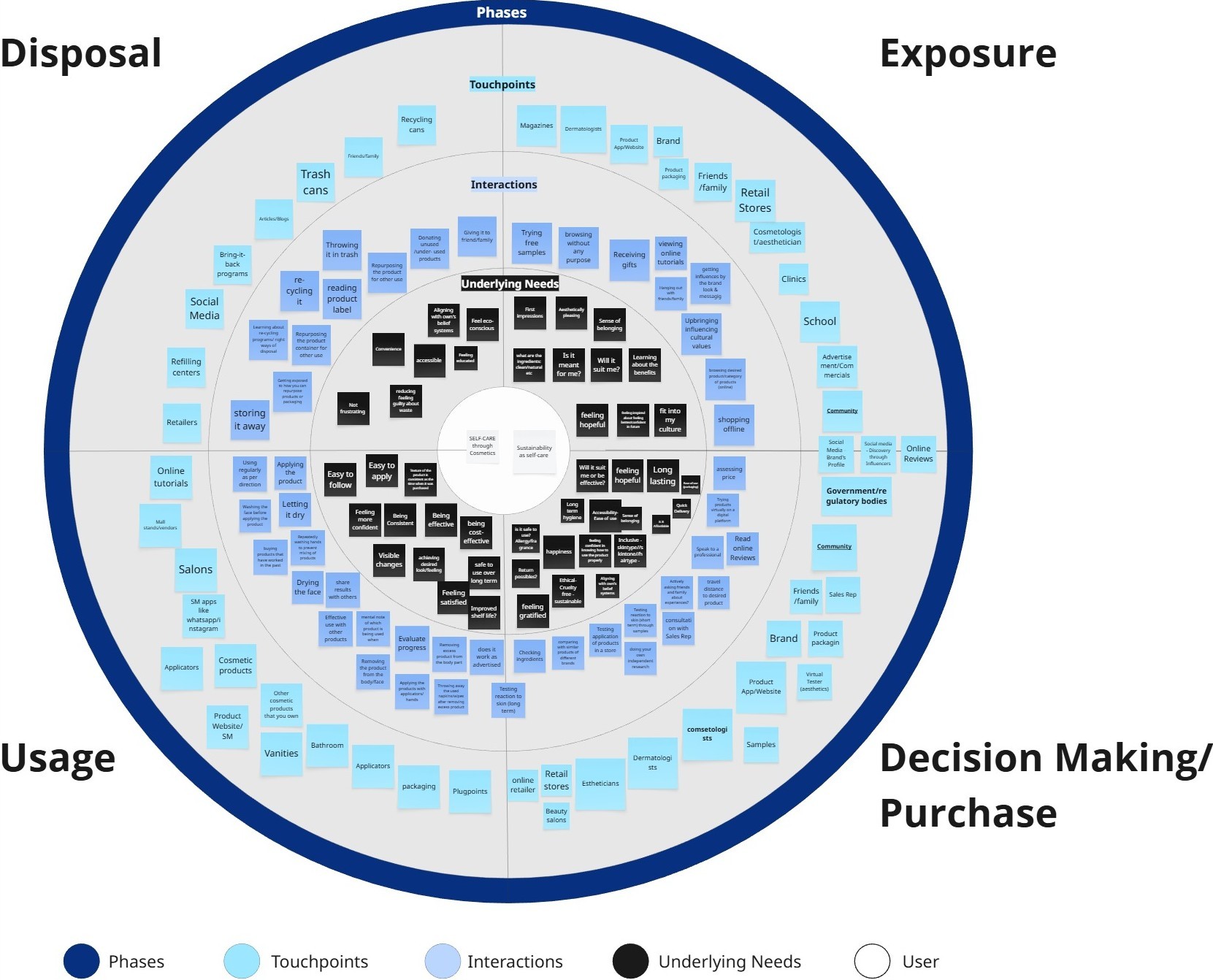
Given time and resource constraints, we focused on the customer as our primary persona and conducted an ecosystem mapping activity to broadly understand their interactions with cosmetics. Rather than narrowing in on sustainability, we mapped key touch points, actions, and needs across four major phases: Exposure, Decision-making/Purchase, Usage, and Disposal.
Co-design
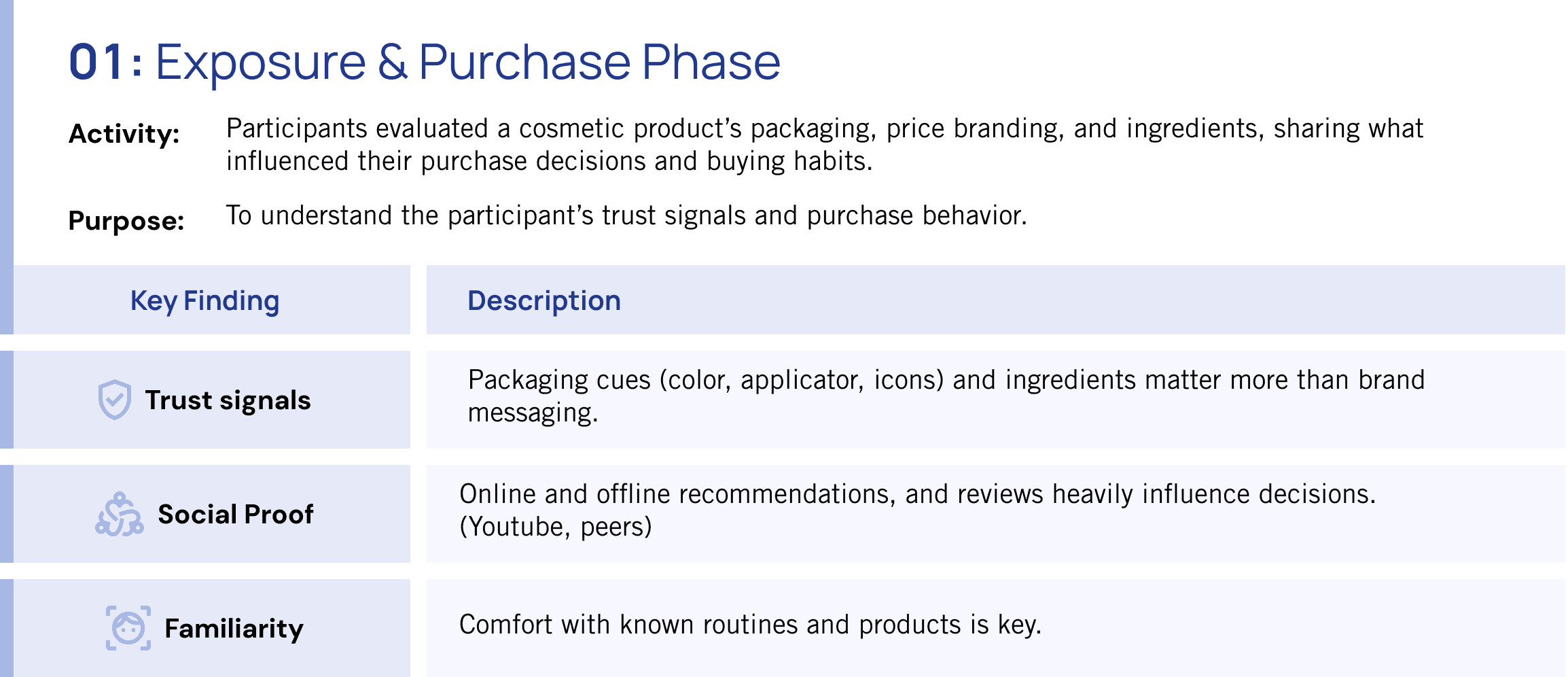
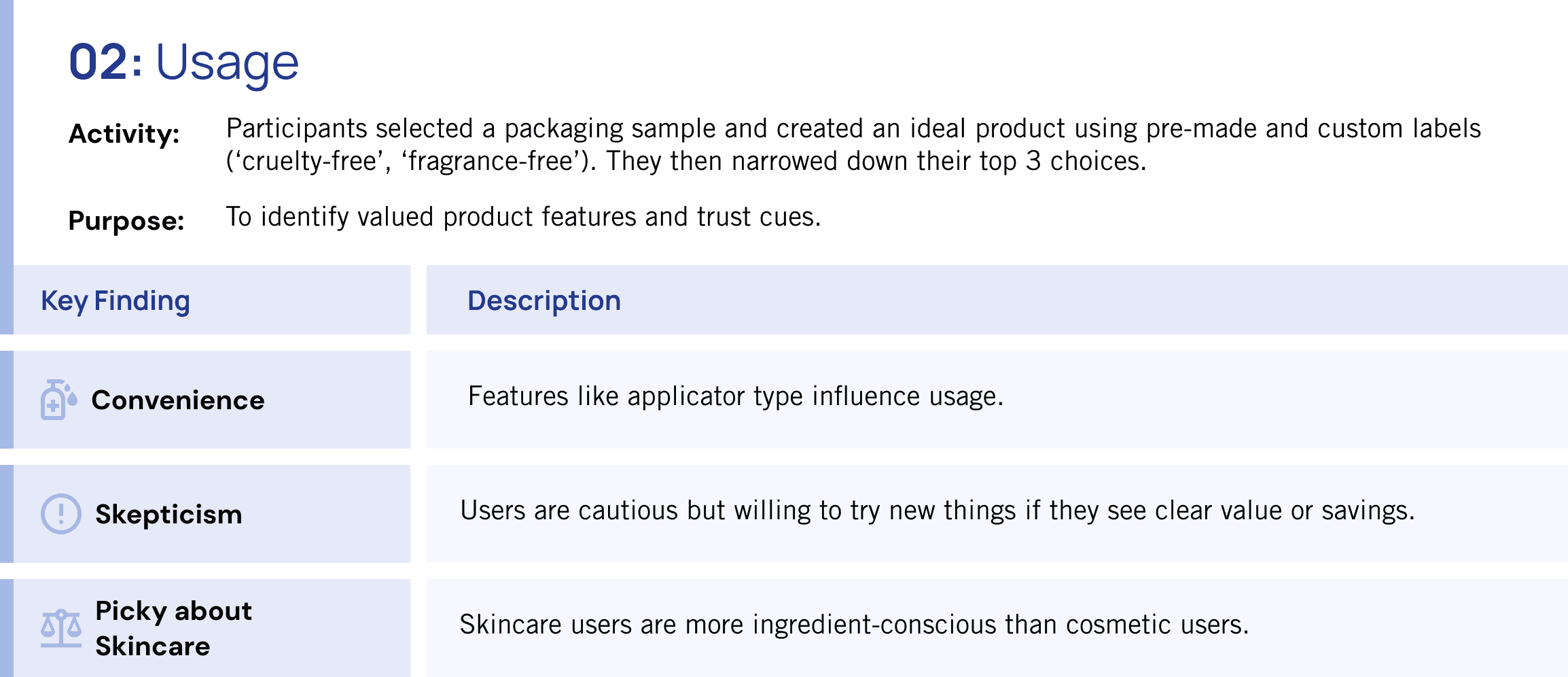
Our co-design session aimed to explore user behavior, values, and decision-making across the cosmetic product lifecycle, from purchase to disposal. Through hands-on and reflective activities, we gathered insights to inform the design of more user-centered and sustainable cosmetic products.
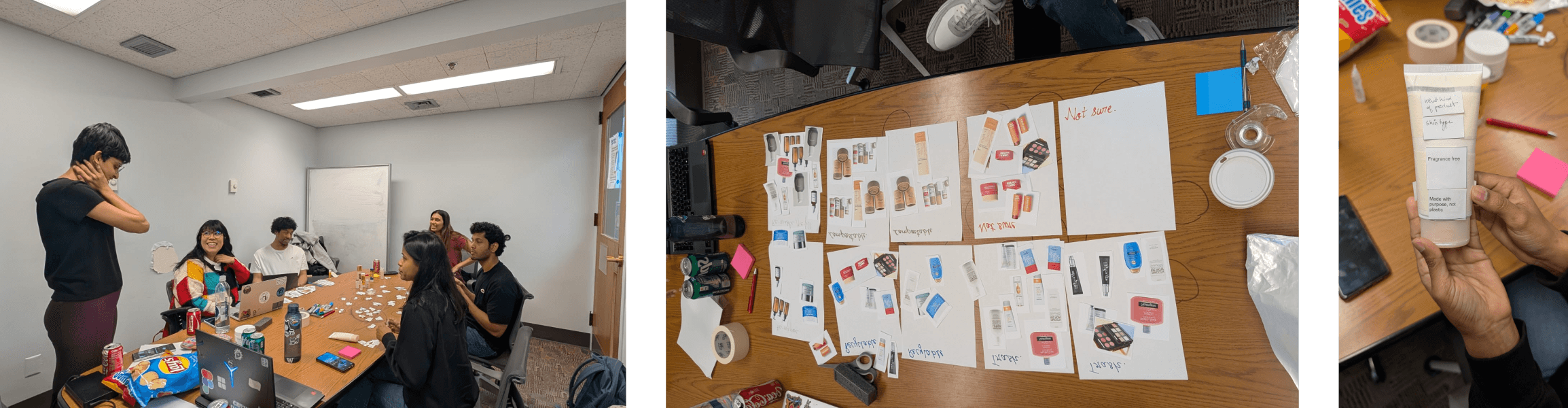
Some criteria we considered to recruit participants and conducting co-design:
Ages 23–27 and mixed gender to capture a range of usage habits.
Regular users of cosmetic or personal care products.
Represented diverse range of routines, values, and familiarity with product categories like skincare and cosmetics.
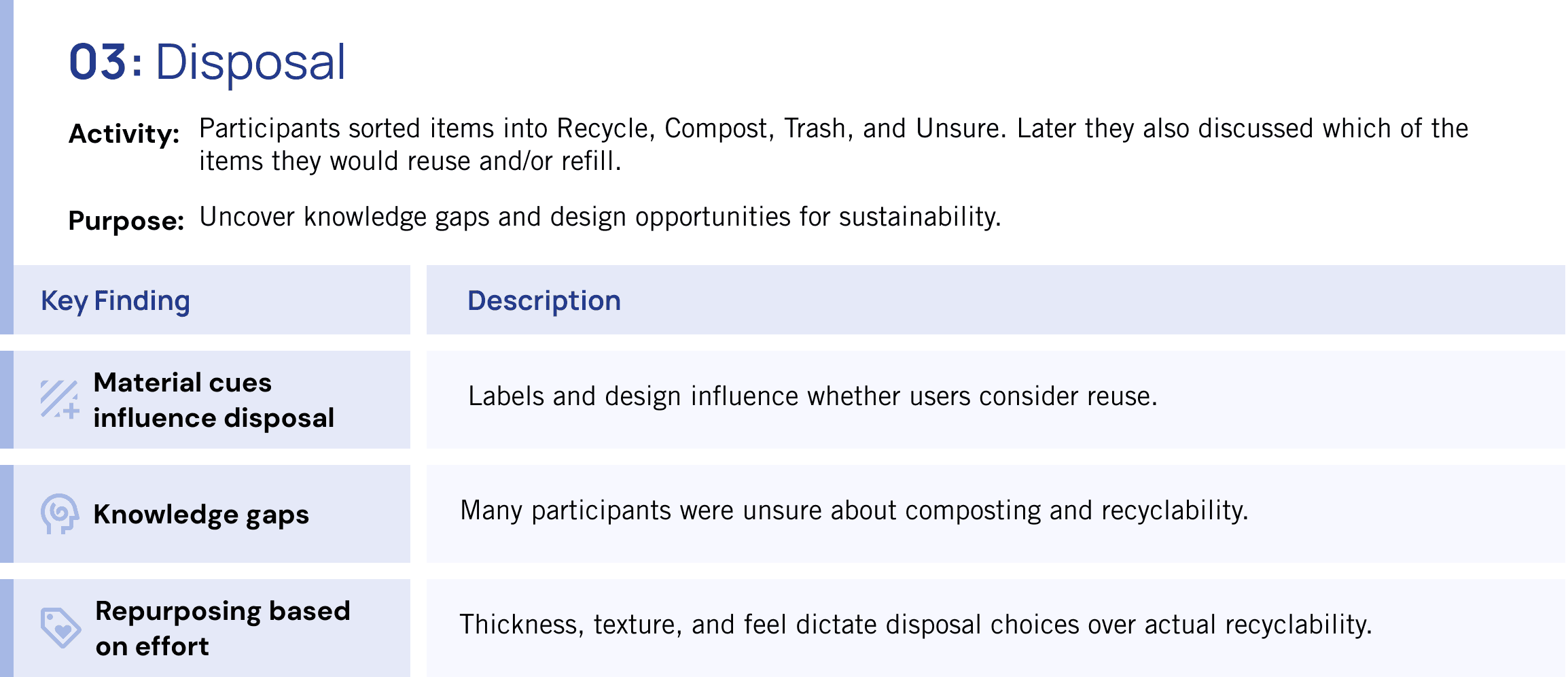
WHAT DID THE CO-DESGIN IMPLY?
The co-design activity helped us influence the direction in which we wanted our scope to be narrowed down but first and most importantly helped us define our design requirements which layed the foundation of our designs.
User Journey
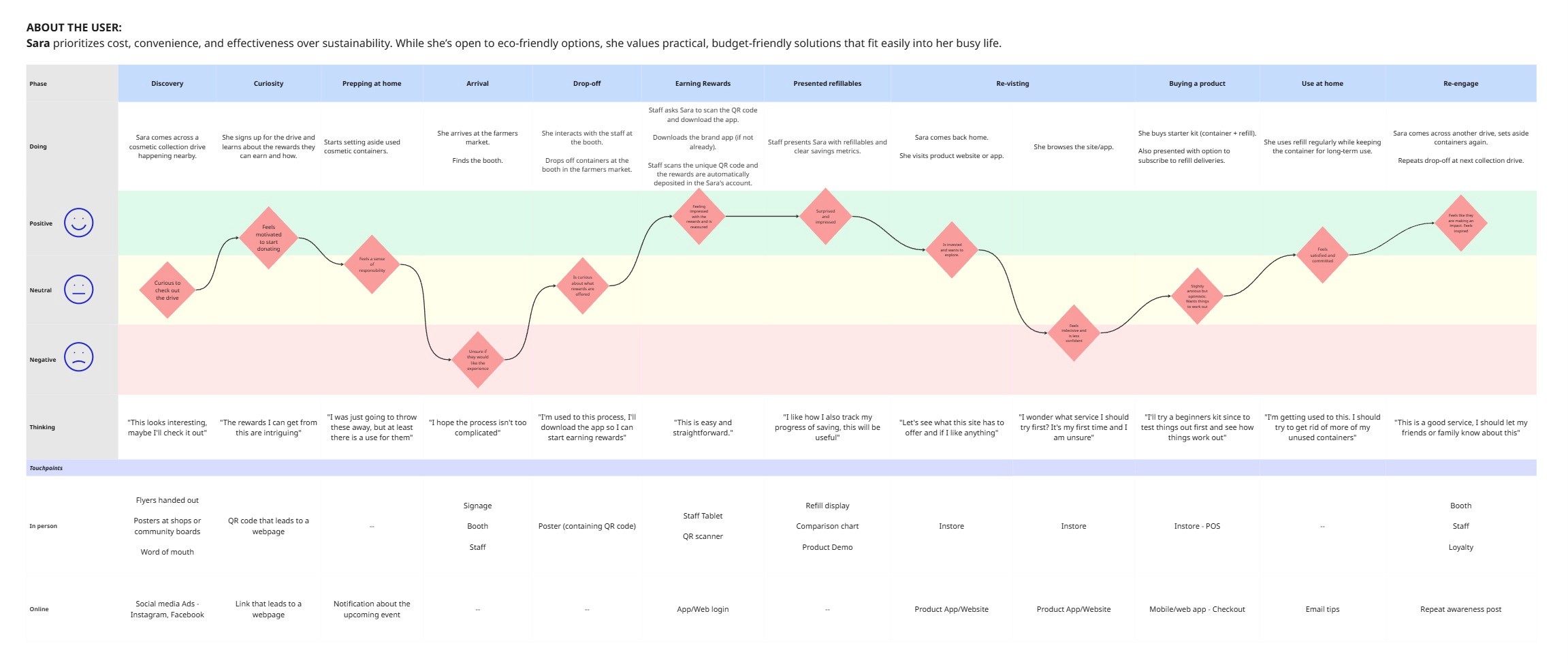
Bottleback has a variety of artifacts that serve as touchpoints for the user. Their journey starts with the user visiting a booth at a farmer’s market. The booth is the initial touchpoint that explains our service with the use of themes and informative signs expressing our values and alignment with Dr. Bronner’s. Once at the booth, the user is presented with a variety of packages and containers that they can interact with and sample with the guidance of employees. The user also is taken through the process of exchanging their used or unused cosmetics at drop offs for a refillable one. Qr codes and a digital app allow the user to see other drop off locations, earn rewards for Dr Bronner products, and track their environmental impact.
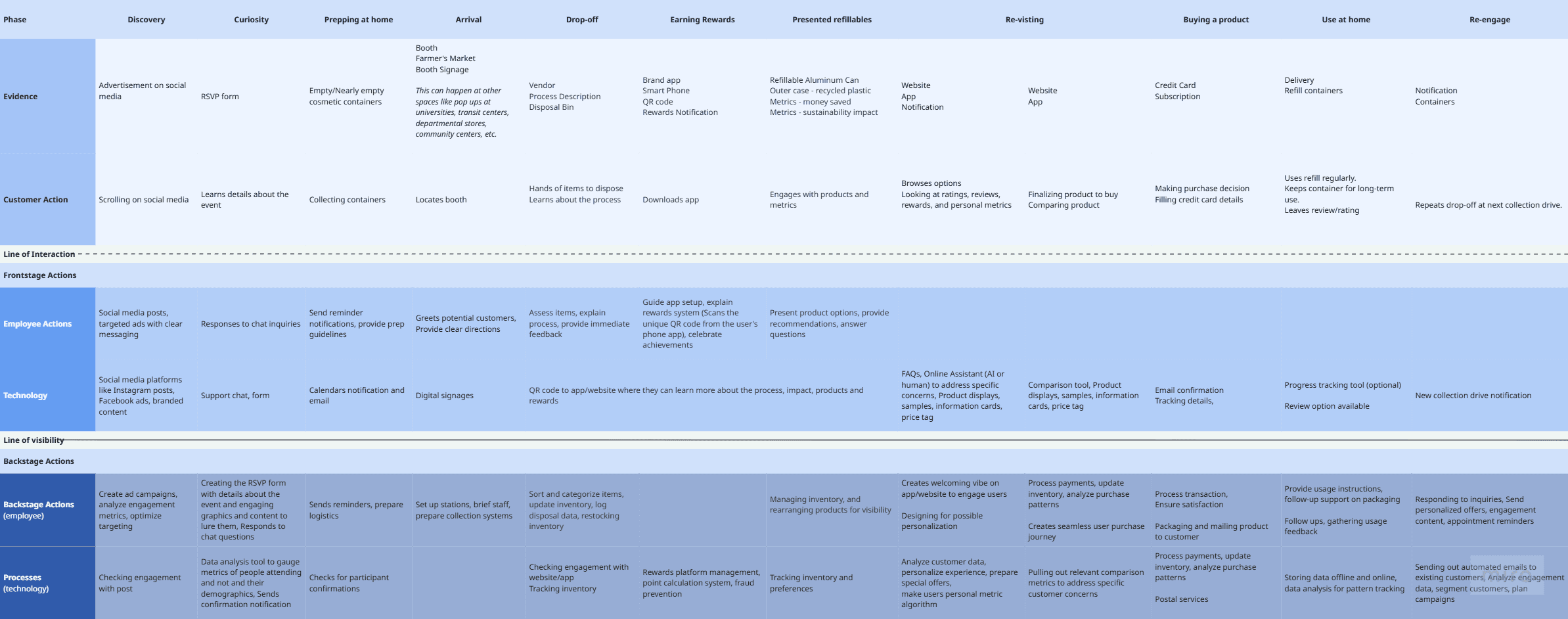
Service Blueprint
We developed a service blueprint to visualize and analyze how our service may be delivered. It maps out our entire service experience from both the user’s and the organization’s (employees and tech involved) perspectives, helping us understand the complex systems and identify areas for improvement and innovation.
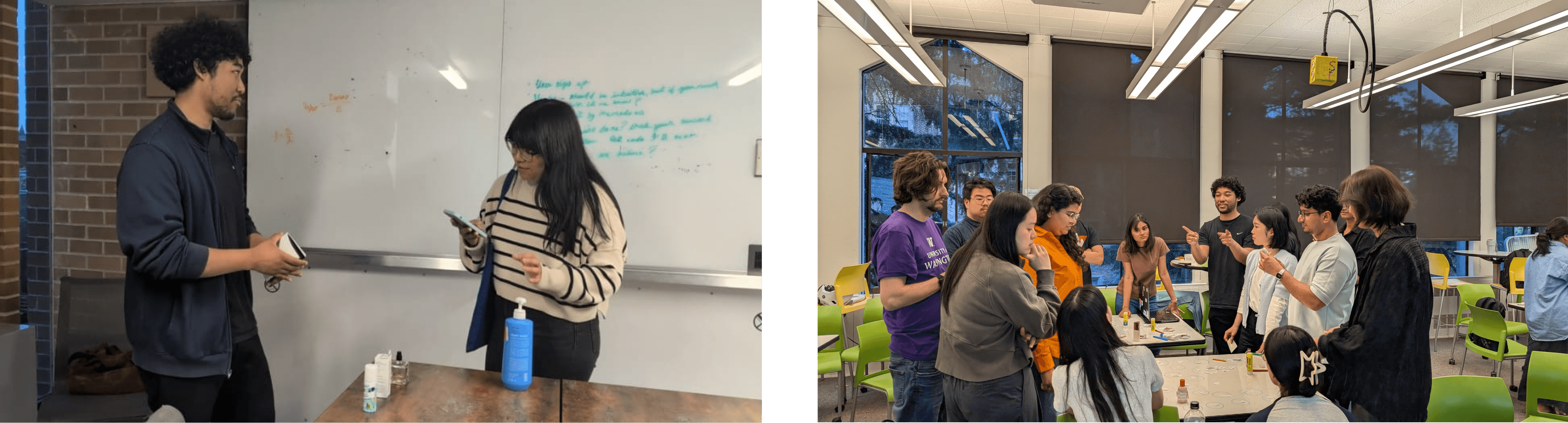
Narrative workshop & Critique
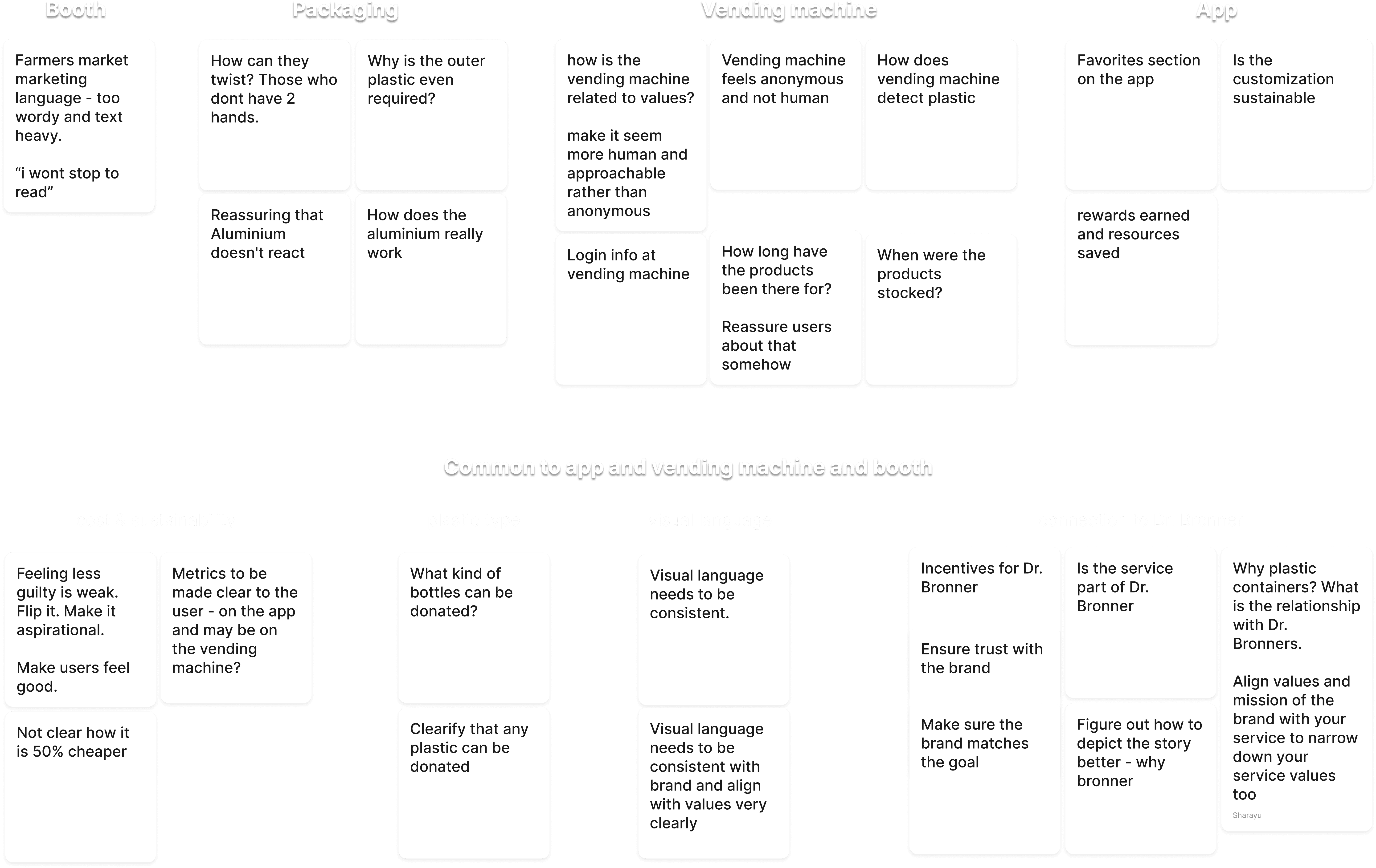
As part of our peer critique process, we gathered feedback from our cohort on two design artifacts: a narrative prototype, where our team enacted the service end-to-end, and a set of design prototypes (booth, packaging, app, vending machine) presented in another class. This activity provided valuable insights into how we could further refine and improve our designs.
The feedback we received from the cohort helped us improve upon the following 4 touchpoints:
THE BOOTH
THE PACKAGING
THE COMAPNION APP
THE REVERSE VENDING MACHINE
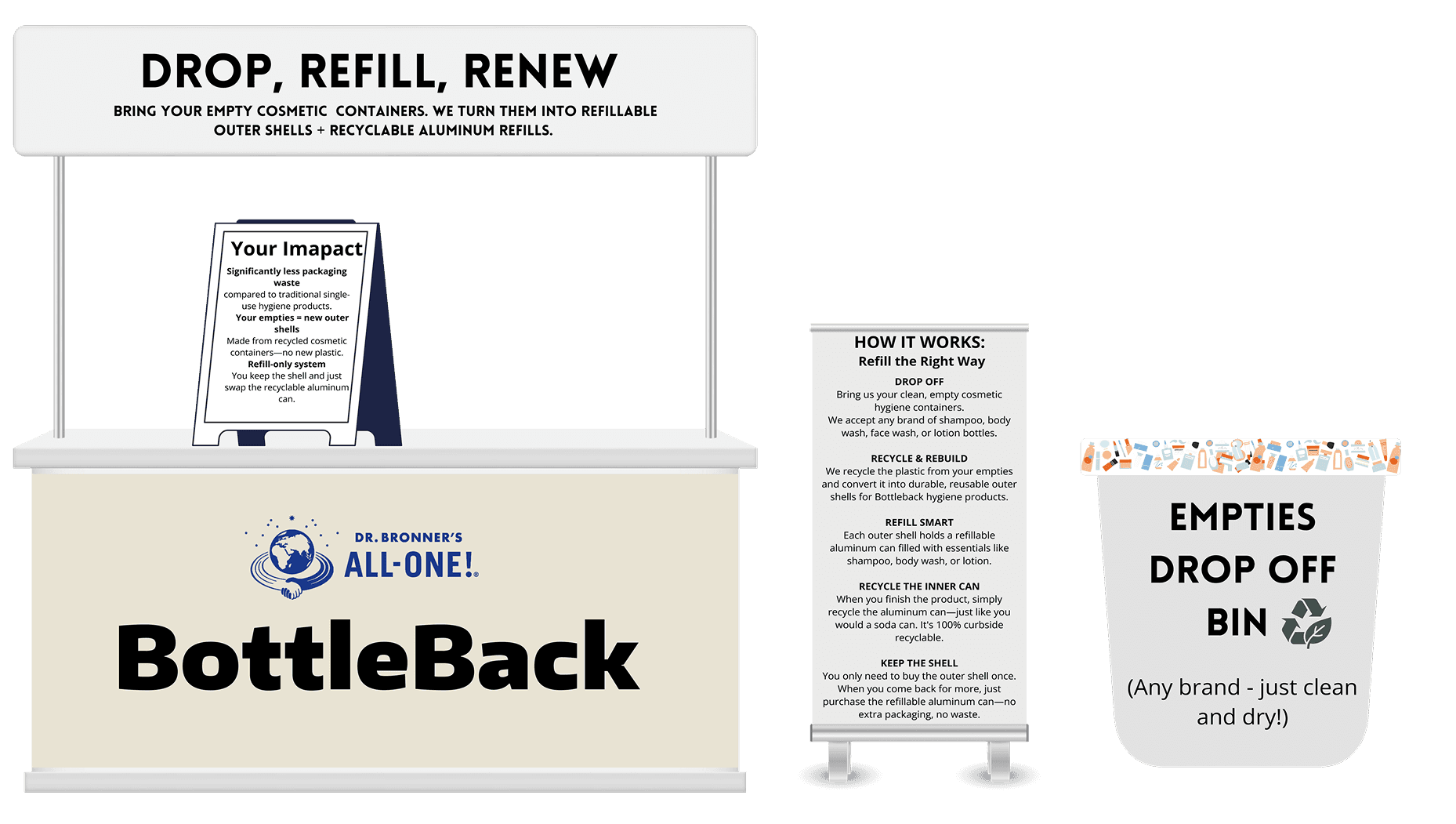
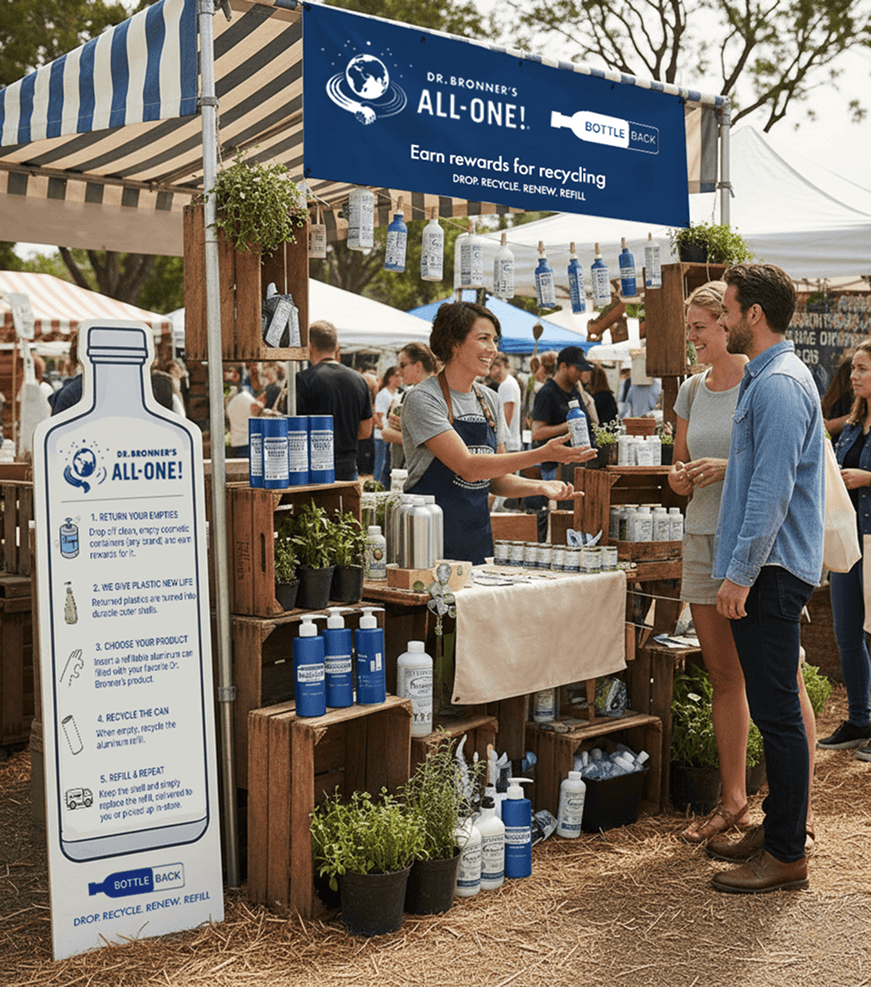
Booth visual: to capture the experience and visual aspects of a user approaching/seeing our booth and marketing experience for the first time. Being able to know immediately how to use our service, and having the opportunity to see and use products.
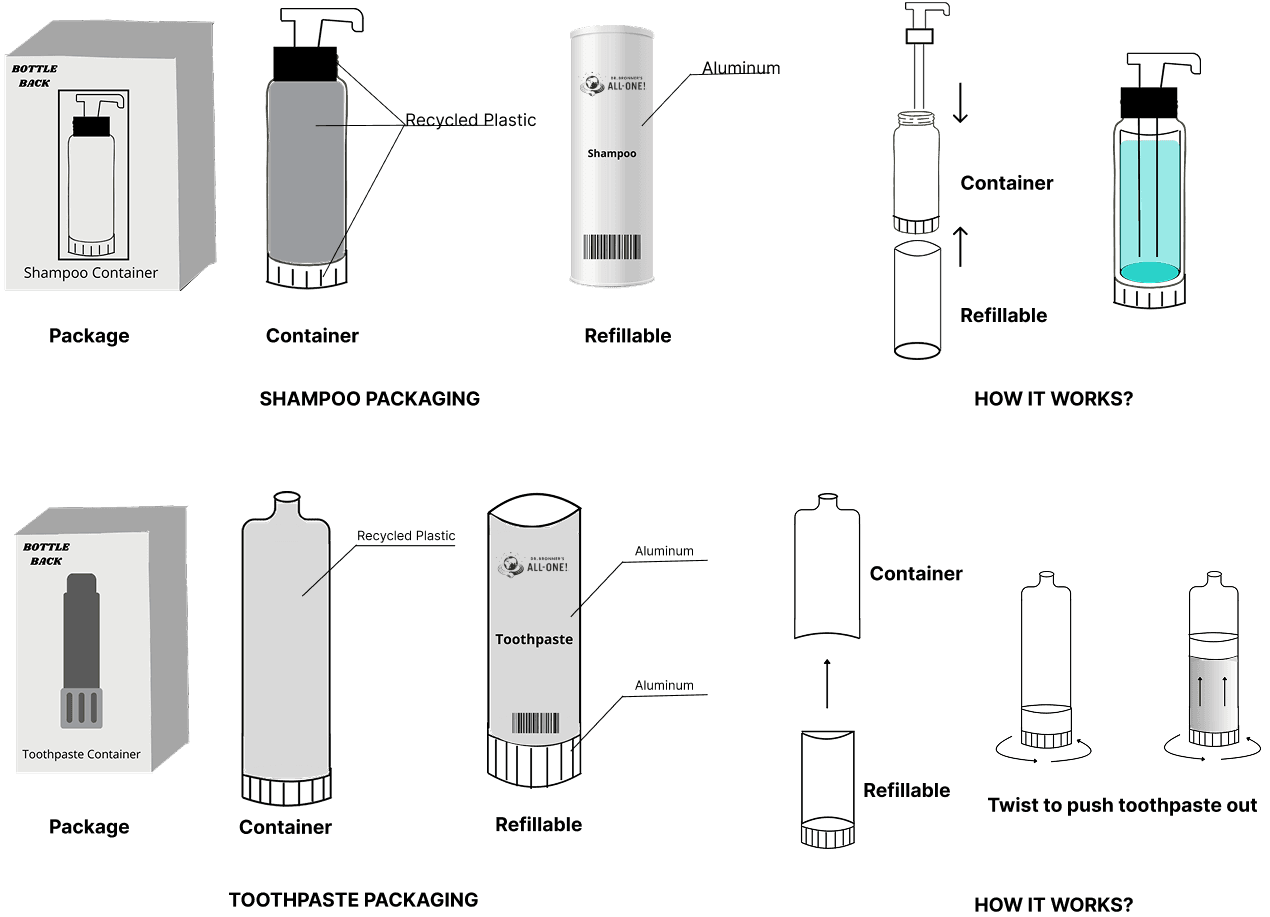
Container: To test how the form or function of a product affects a user’s interaction and ideas about the service. We can explore how a sustainable product might be integrated into everyday routines. It can also help us demonstrate the intuitiveness and convenience of a sustainable cosmetic.
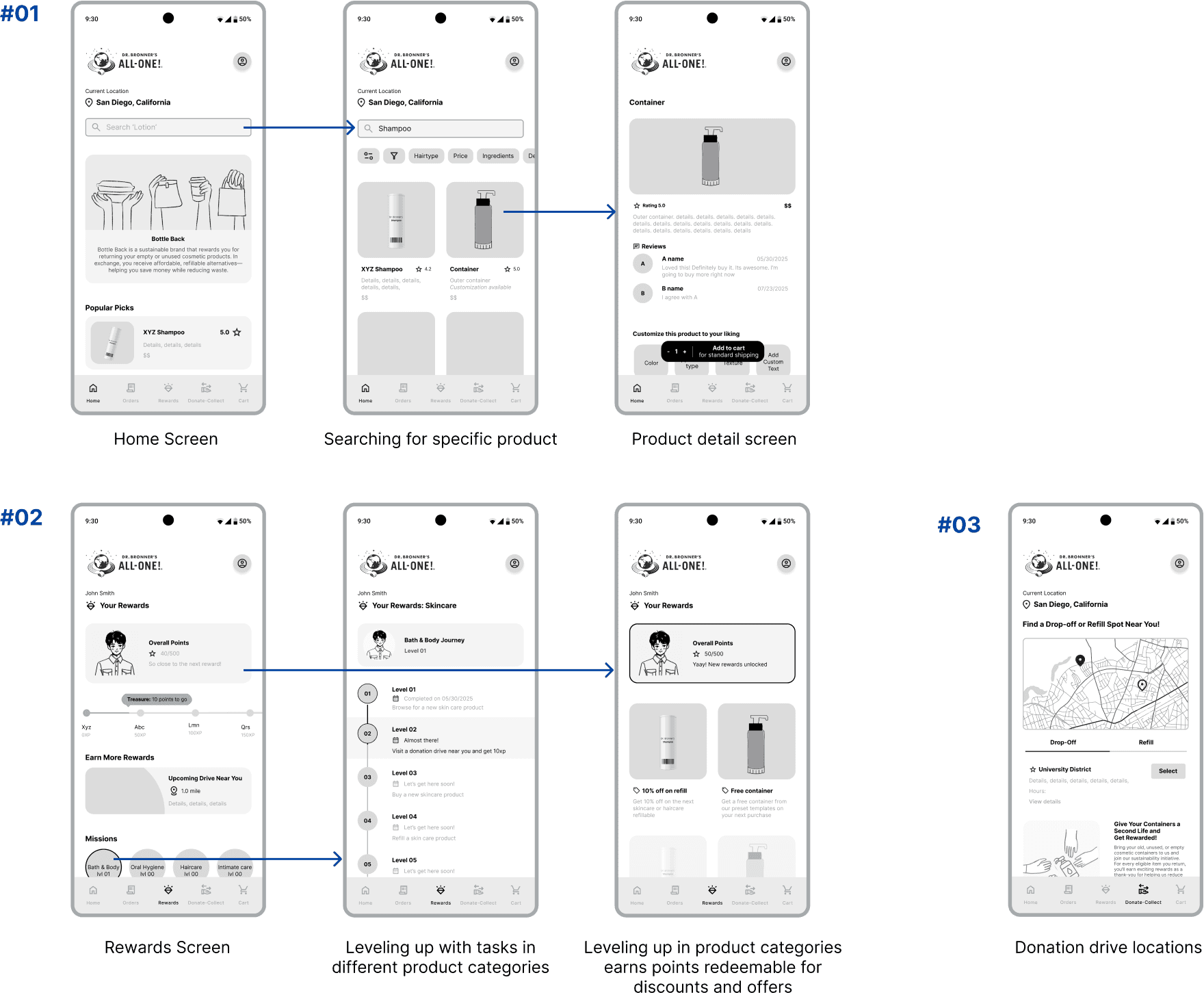
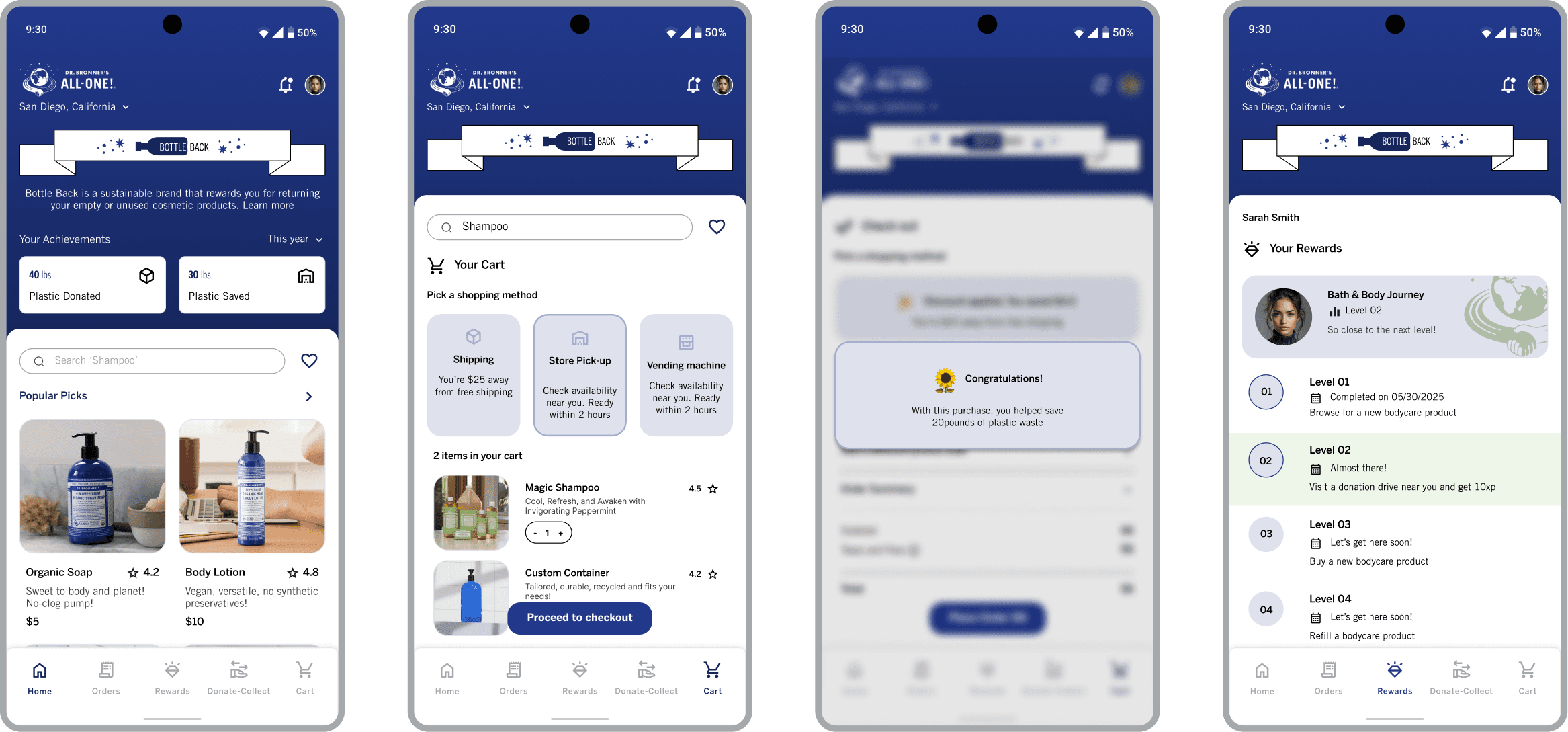
App offers a seamless and sustainable shopping experience. It allows users to:
Discover and purchase products tailored to their needs
Nudges users to buy companion refillable, eco-friendly packaging
Customize containers to match their functional and visual preferences
Complete sustainability-focused challenges and earn rewards
Easily donate used containers for recycling
Locate nearby vending machines or order products online
By integrating sustainability into everyday routines, our app empowers users to make eco-conscious choices effortlessly.
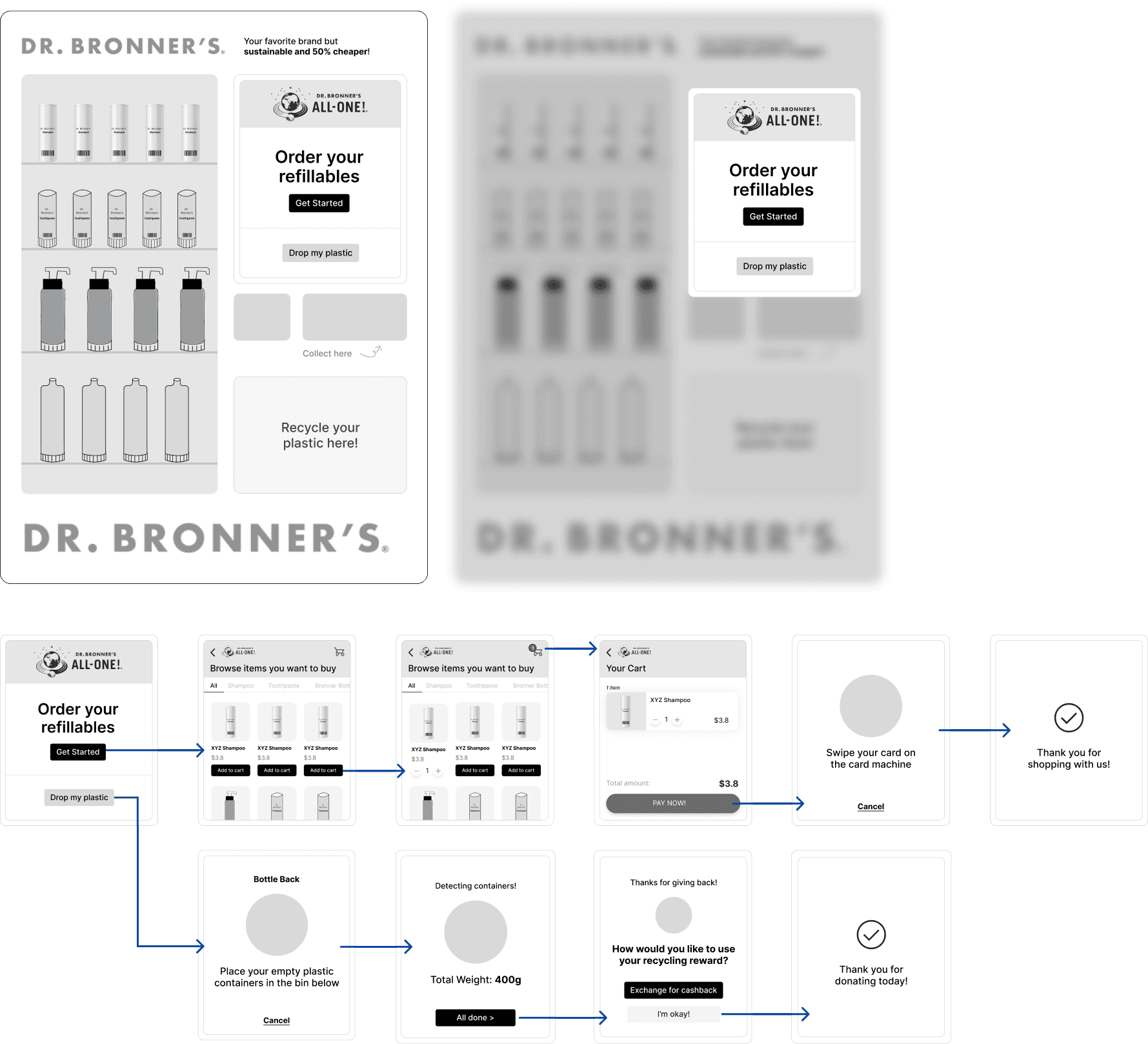
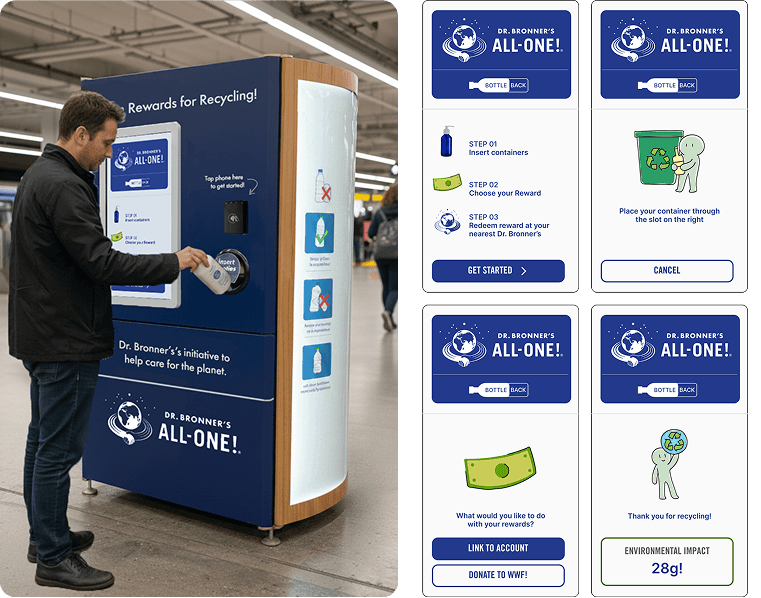
Vending Machine: We designed the vending machine to offer a practical, low-barrier way for customers to return used containers and purchase refills without needing to visit a store. It increases accessibility, reduces logistics costs, and supports a self-service model that scales easily in urban spaces.
FEEDBACK FROM THE CRITIQUE:
Final Solution
016
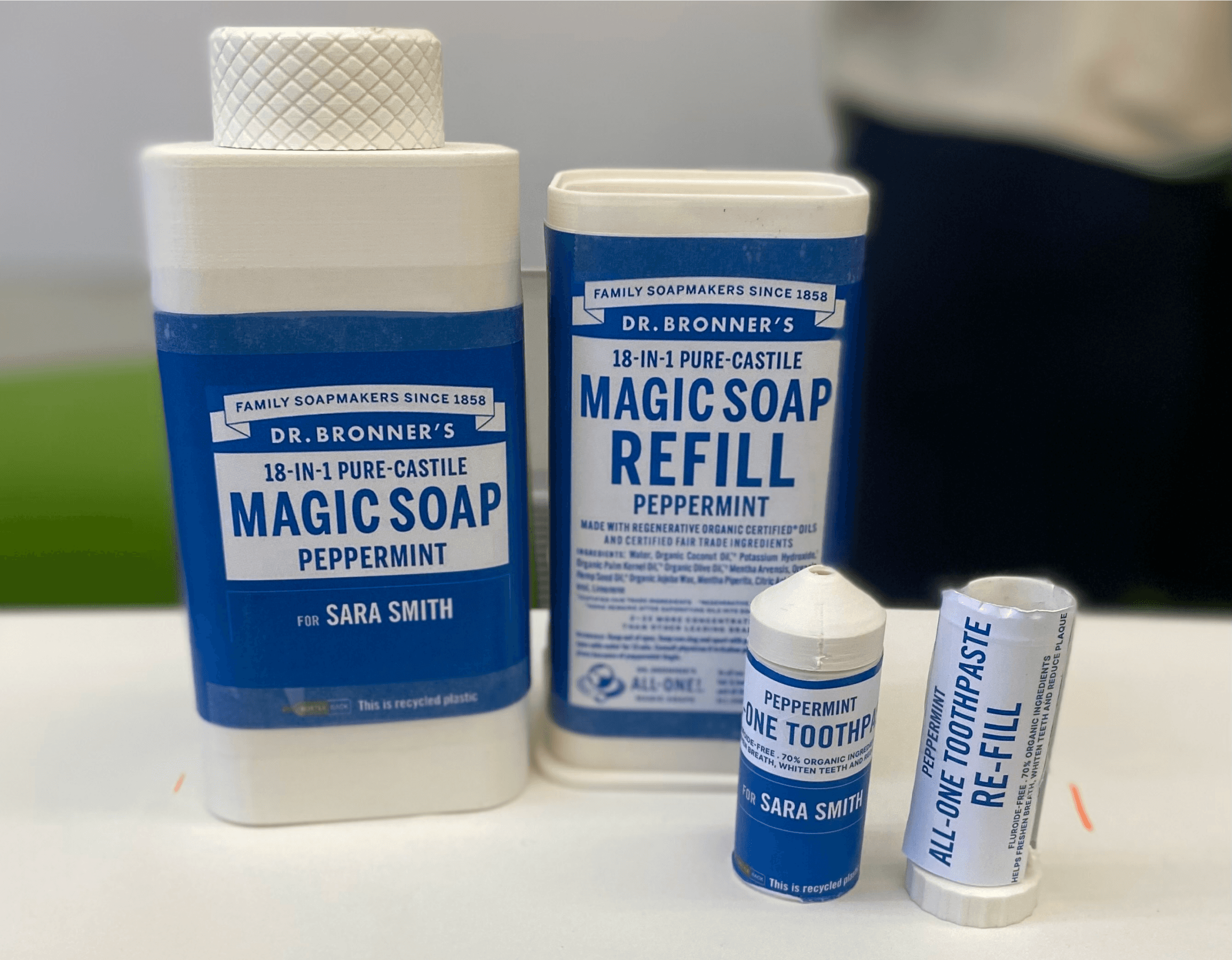
The Refillables
The refillable container serves as one of BottleBack’s core product artifacts. It is designed to reduce waste while maintaining convenience, offering a durable, user-friendly system. The container features a reusable outer shell made from recycled cosmetic plastics and an inner aluminum cartridge that can be refilled or recycled. This design empowers users to make sustainable choices effortlessly, integrating into their routines with ease.
The Booth
The booth prototype serves as one of our first user-facing touchpoints. It functions as a marketing artifact to promote BottleBack, provide an overview of the service, and offer giveaways through a spin wheel such as a free shell or a coupon. Users will be able to purchase BottleBack products at the booth and speak with a specialist who can guide them through the service and answer any questions.
The Companion Application
The app serves as a convenient touchpoint, allowing users to shop from the comfort of their homes. It also helps them locate nearby donation drives or reverse vending machines. With every purchase or donation, users are informed about their environmental impact and economic savings. They also earn rewards that can unlock new benefits, encouraging conscious and responsible choices.
The Reverse Vending Machine
The reverse vending machine serves as a key touchpoint to promote sustainable behavior while prioritizing convenience. In addition to contributing to sustainability, customers receive financial rewards that can be redeemed on their next Dr. Bronner’s purchase.
Scope
019
Future Scope
The objective of the project was to focus on designing a speculative, sustainable closed-loop service that incentivizes returning and refilling personal hygiene and cosmetic product containers to reduce waste and benefit consumers, businesses, and the environment.
To achieve this and take the project forward the following could be done :
Deeper stakeholder value:
Explore how the system could enhance experiences for both employees and employers by prioritizing well-being, agency, and long-term value creation—not just profit optimization.
Expanding the product ecosystem
Extend the framework beyond the personal hygiene products studied, and examine how introducing categories would impact design decisions across manufacturing, packaging, distribution, and end-of-life touchpoints.
Cross-industry application:
Apply learnings to adjacent waste-heavy industries like beauty and cosmetics, which generate significant waste and present distinct regulatory, material, and behavioral challenges.