Qualitative Study on Urban Planners' Experiences with Gen AI
Gen AI
Qualitative Research
Urban Planning
Project
001
Studying the impact on our built environments
As generative AI adoption in architecture and engineering firms jumped from 38% to 53% in just one year (2024-2025), our team investigated how urban planning professionals are integrating these tools into their workflows. Through ethnographic interviews with professionals across the United States, India, and China, we uncovered the motivations, challenges, and identity shifts shaping this technological transformation.
Details
002
Role
UX Researcher
Timeline
03 Months
Collaborators
Ishita Kohli, Celia Tsao, Jesse Yu, M’Nya Preston, Tsai-Ping Kuo
Tools
Ethnographic Interviews
Thematic Analysis
Artefact Walkthroughs
Overview
003
Research Goal 🎯
Investigate how urban planning and architecture professionals are integrating GenAI into their workflows, examining motivations, implementation strategies, values, concerns, and impacts on professional identity within this community of practice.
Current Industry Context 👩💼
53% of A&E firms now use AI tools (up from 38% in 2024). GenAI applications include sustainable building design, urban visualization, and optimizing wind resistance and natural lighting in major projects like Shanghai Tower.
Why This Matters 💡
As professionals shape our built environment, understanding their GenAI adoption patterns is critical for tool development, workflow optimization, and addressing the evolving relationship between human expertise and AI capabilities in design practice.
Value to Stakeholders 🎁
Delivers actionable insights for practitioners, firms, AI developers, and researchers on:
🪟
Effective GenAI strategies
🌿
Key limitations, workarounds, & unmet needs
✨
Opportunities for innovation and market growth
What are we exploring
004
Research Question
How do urban designers and architects apply GenAI tools in their city planning and design workflows?
THIS LEAD US TO EXPLORE THE FOLLOWING SUB-QUESTIONS:
How do urban planners and designers make sense of the role of GenAI in their work, and what they hope it might enable?
How do planners/designers incorporate GenAI tools into their workflow (e.g., visualization, proposal drafting, community engagement), and how do these tools shape their daily routines, decision-making processes, or creative practices?
How do they interpret value, evaluate risks, and navigate the challenges of GenAI in their projects?
How do professionals learn about, experiment with, and adapt GenAI tools, and how does that process affect how they perceive their professional identities and responsibilities?
Research Timeline
005
Who we talked to
006
The Participants
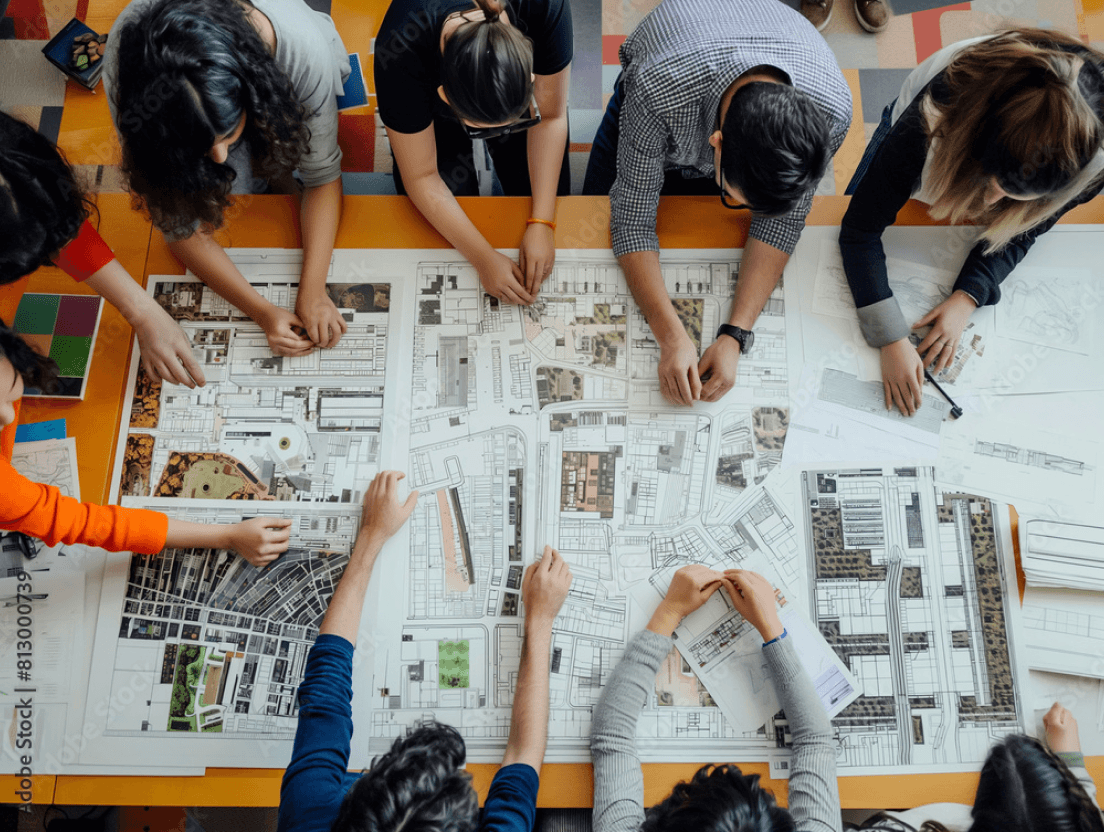
Our participants included a Product Designer (formerly an architect), the Founder of an urban design firm, a Community Designer, and a Program Manager. Their diverse backgrounds spanned the United States, India, and China, bringing varied perspectives on GenAI implementation across different cultural and regulatory contexts.
4 Participants
🧔🏼♂️
Product Designer (formerly an architect)
👩🦳
The Founder of an urban design firm
🧑🏽🦱
Community Designer
🧑🏼🦰
Program Manager
3 Countries

United States

India

China
10 GenAI Tools

Key Findings

FINDING 1
AI adoption starts with pressure and passion
Professionals adopt GenAI driven by both external pressures (time constraints, peer influence) and internal motivations (job market concerns, positive experiences), though hesitation remains around over-dependency.
Internal Motivations
“The need for fast design and the reality of limited working time. Generative AI helps us meet demands quickly and cheaply.” - P2
External Motivations
“So it just seems like finally the firm is in a place where they realize that there is no avoiding it and they started to implement it slowly.” - P4
Hesitation
“So I am scared that, you know, one day we'll all just lose our consciousness and be doing a very fictional thing.” - P3
FINDING 2
GenAI finds its groove in the early-to-mid design stages
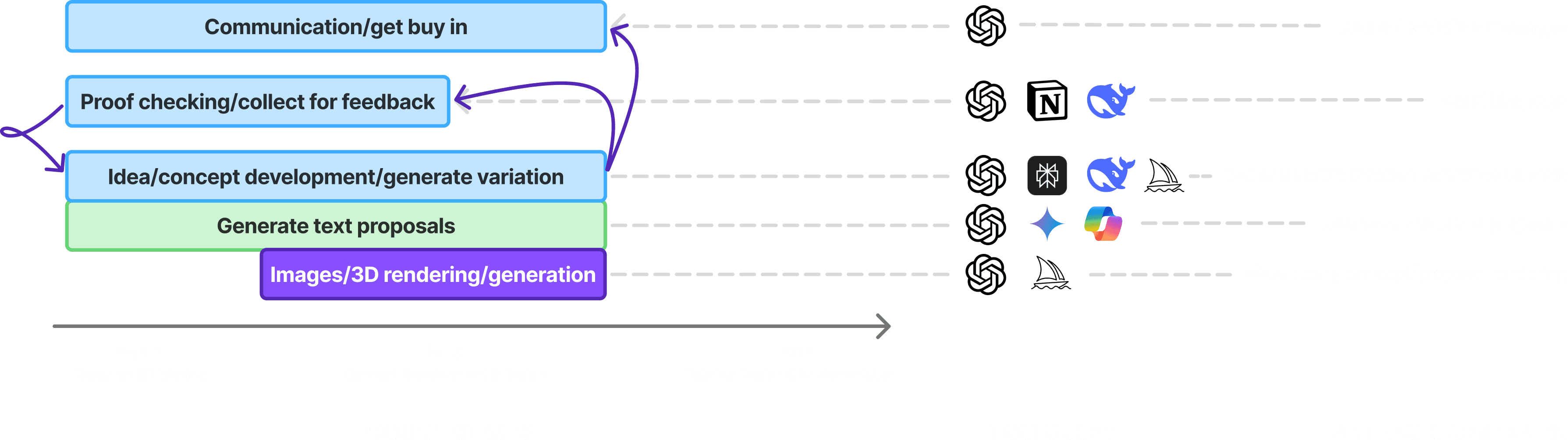
Tools are most valuable during research, visioning, and concept development for ideation and stakeholder buy-in, but see limited use in detailed implementation where precision is critical.
“Although it’s not always accurate, it’s useful in early-stage work to "satisfy" clients initially.” -P2
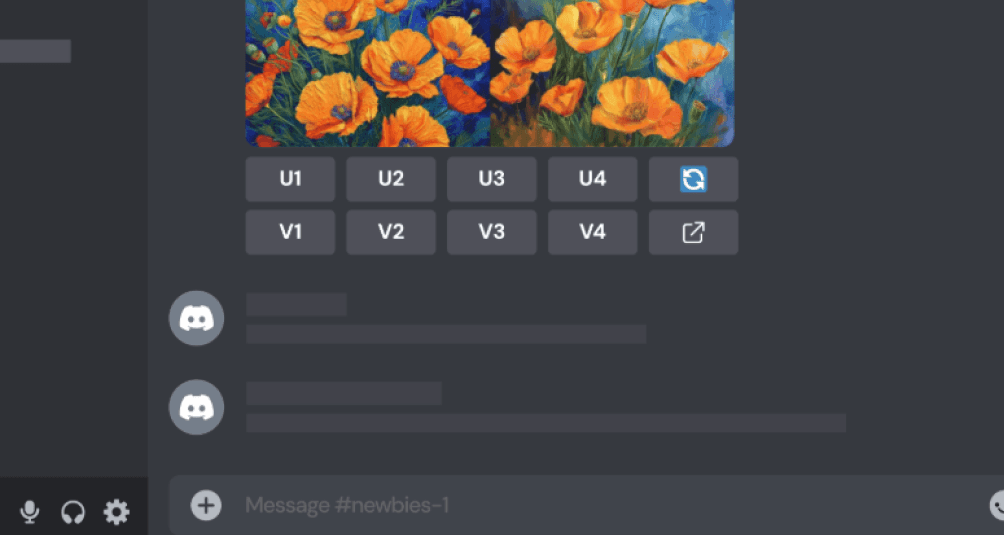
“It's like a circular process where I'm using Midjourney more for iteration and generation, and ChatGPT to get more direction.” -P4


FINDING 3
How you see GenAI shapes how you use it
Professionals who view GenAI as a collaborative "peer" use it for creative dialogue and critique, while those who see it as an "assistant" leverage it for refinement and polish—both requiring iterative prompting.
Perception of GenAI (Peer vs. Assistant)
“I give them a persona through whose lens they try to critique my work.” - P4
“I’m using it almost as if it’s a Google search.” - P1
Prompt Iteration / Chain Prompting
“It’s just repetition and giving it more clarity and direction.” - P3
Providing Rich Context (Persona / Goals / Style / References)
“We uploaded the reference images to AI along with a text description of what we wanted.” - P2

FINDING 4
Speed vs. Precision Trade-off
GenAI significantly accelerates workflows and helps build stakeholder alignment, but outputs consistently lack the detail and accuracy required for industry standards.
Values
Speeds up the process
Helps build stakeholder buy-in
“I can see that the speed at which I was doing that freelancing work was much more faster.” - P3
Limitations
Lacks precision and originality
Falls short of industry standards
“After some adjustments, it was just barely acceptable for the project.” - P2
“Back to architecture school, I would spend so much time building like a little prototype of design, and maybe in that process I would discover something else that now I'm skipping the process and I might get a lot of different options applied.” - P3
FINDING 5
Professionals Maintain Agency
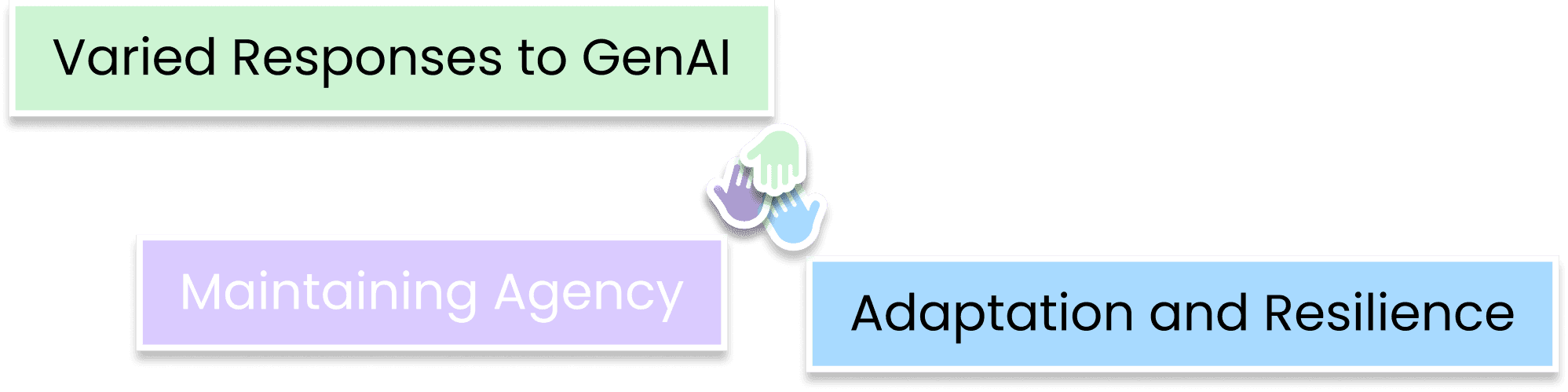
Despite concerns about job security, professionals view GenAI as an enabler that changes how they work while they retain final decision-making authority and creative control.
“AI can spark new ideas, but the core always has to come from you.” -P2
“How can I make sure that we don't become irrelevant or less valuable to our clients because of the existence of these tools?” -P1
Translating the research to design
007
Design Implications
Although GenAI is not yet fully integrated into urban planning and design workflows, its potential role in future design processes remains widely discussed. This study finds that while professionals’ responses vary by background and experience, they consistently emphasize the importance of human expertise and agency in their work.
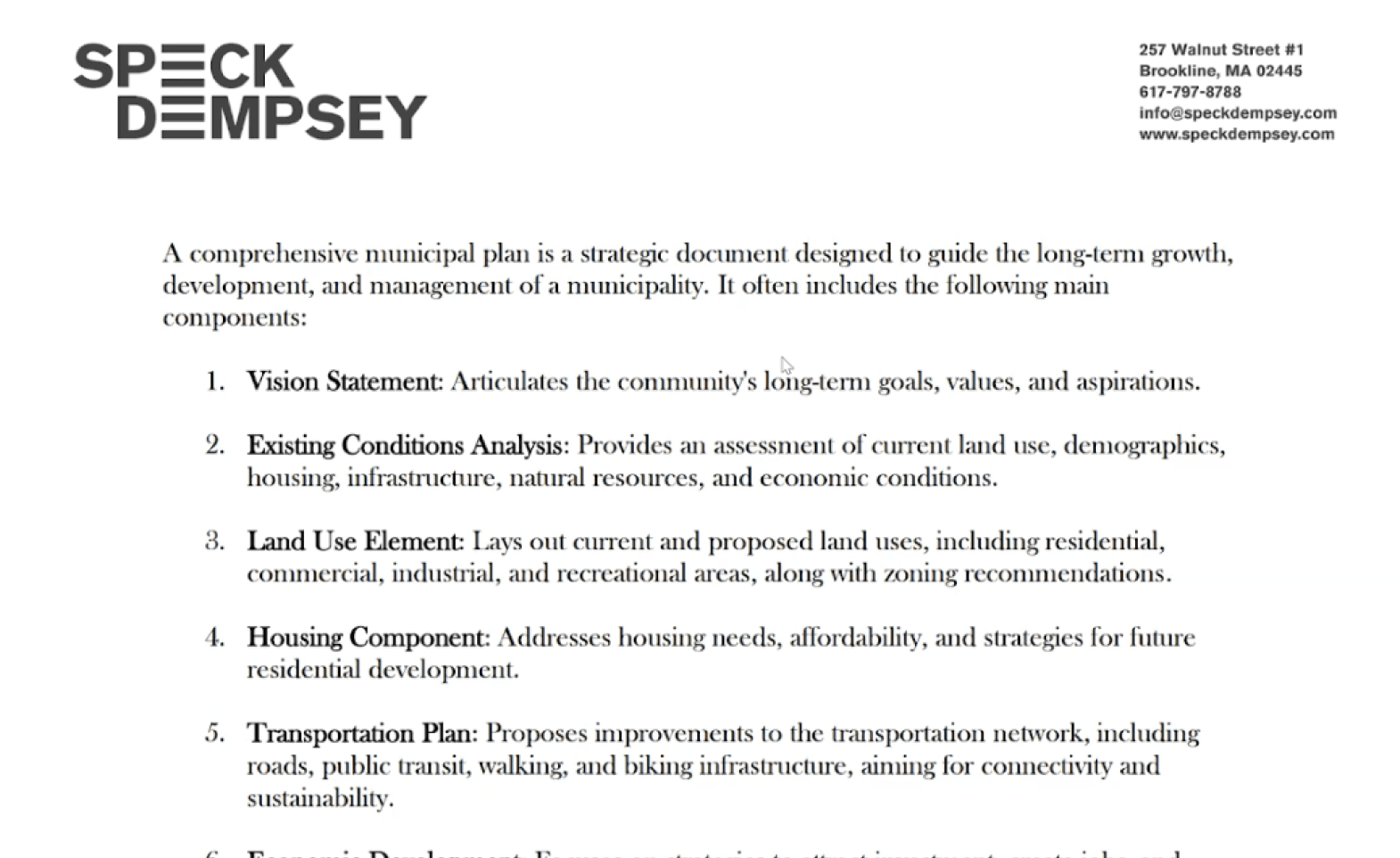
Current GenAI use remains limited, with text-based tools predominating and image-generation tools still immature; consequently, GenAI is used mainly for documentation, planning, and analysis rather than design production. In light of these constraints and the emphasis on human agency, two key implications emerge:
01
GenAI Built for the Field, with Urban Planners in Mind
Future tools should embrace "Human-in-the-Loop" and "For us, by us" frameworks, enabling professionals to adjust, override, and trace AI outputs. Critical elements must remain under human control:
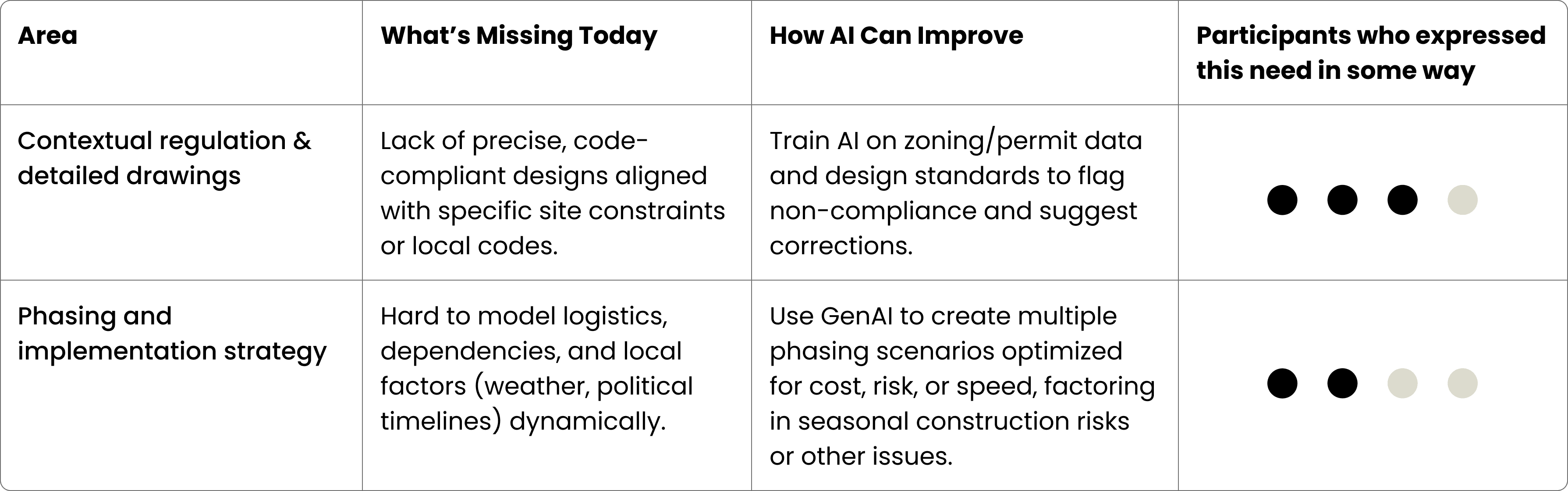
Regulatory compliance and code requirements
Real-world constraints and feasibility assessment
Depth and nuance of local context
Creative originality and judgment

02
Enhance GenAI to Maximize Creative Input and Design Output
Tools should be refined to support designers' creativity across the workflow by aligning strengths with professional needs:
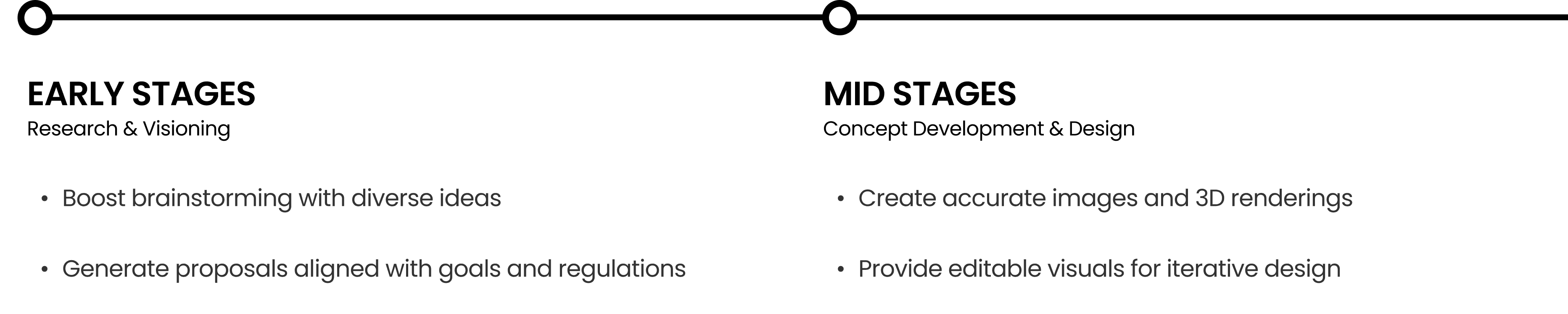
Early Stages: Boost brainstorming with diverse ideas and generate proposals aligned with goals and regulations
Mid Stages: Create accurate images and 3D renderings, provide editable visuals for iterative design
03
Exploring Barriers to Late-Stage Adoption
Two critical areas need development for GenAI to be viable in detailed design phases:
The Potential Impact of the Research
008
Research Implications
This study provides actionable insights for multiple stakeholders:
01
For Practitioners:
Guidance on when and how to effectively integrate GenAI into existing workflows
02
For AI Developers:
Understanding of unmet needs and opportunities for field-specific tool development
03
For Firms:
Strategies for training teams and implementing GenAI adoption policies
04
For Researchers
Foundation for future studies on AI's impact on creative professional identity
How to take this forward
009
Research Opportunities
Several important questions remain open for future investigation:
01
Longitudinal Studies:
Track real-world planning projects using GenAI end-to-end to understand its impact across the entire design lifecycle
02
Trust & Risk Assessment:
Investigate issues around trust, legal risk, output fidelity, and integration challenges that prevent late-stage adoption
03
Cross-Cultural Adoption Patterns:
Expand research to more geographic regions to understand how cultural and regulatory contexts shape GenAI usage
04
Impact on Professional Development:
Study how GenAI affects training, education, and skill development for emerging professionals in urban planning
Learnings
010